
The project started with the release of the details of the XXVIII. Hungarian National Scientific and Innovation Competition for Youth. Bence Horváth and Robert Hutter began working out the base concept of the network.
Life-saving Drone Network
About this project
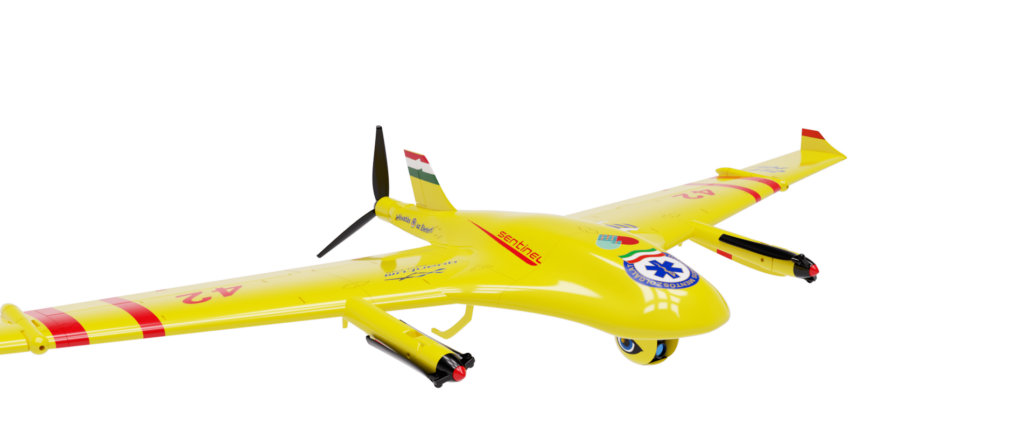
This project was initially created as part of the XXVIII. Hungarian National Scientific and Innovation Competition for Youth. Project members Bence Horváth and Robert Hutter entered the competition with the idea of an innovative life-saving drone network, which would deliver defibrillators to patients in critical condition. At the end of the competition, a 22-page study was presented, discussing the concept of a fixed-wing VTOL drone network consisting of 80 nodes, which could save thousands of lives every year. In addition to the study, a scaled model named Sentinel of such a life-saving drone was designed, 3D printed, and assembled. In recognition of their comprehensive research, the authors received the Jury’s Prize at the scientific contest. Months after the release of the study, the Hungarian National Ambulance Service, which served as a close partner in the writing of the study, prototyped and presented a life-saving drone to the public.
Project timeline
Bence and Robert were invited to the Headquarters of the Hungarian National Ambulance Service to gather information about how pre-hospital care works.
The jury of the competition accepted the proposal to research the concept of a life-saving drone network.
Bence and Robert were invited to the Headquarters of the Hungarian Directorate for Disaster Management to discuss the other potential applications of the drone network.
The two engaged in technical conversations with the representatives of Quantum Systems Gmbh, MP Drone Series, and FLIR to gain insights into available drone technologies.
As part of the scientific contest, all participants were invited to present and consult with the National Research, Development, and Innovation Office. Following the consultation, the office invited Bence and Robert to further elaborate and present to Dr. Zoltán Birkner, the Chairman of the Hungarian National Research, Development, and Innovation Office. The discussion far exceeded the original scope of the competition and touched upon further development and financing opportunities.
To obtain a practical perspective on pre-hospital care, Bence and Robert were invited to the Buda II. ambulance station to speak with local field experts. The image was taken at the station with Robert Hutter (left) and Bence Horváth (right).
Bence Horváth and Robert Hutter completed their 22-page study on "The Use of Fixed-Wing Unmanned Areal Vehicles in Emergency Medical Care" and presented it to the jury.
In recognition of the detailed research, the two authors were awarded the Jury's Prize at the XXVIII. Hungarian National Scientific and Innovation Competition for Youth.
Following the completion of the study, the two authors were invited to present to Gabor Csato MD, MSc, the Director of the Hungarian National Ambulance Service. On the image above, Pál Győrfi, spokesman of the National Ambulance Service can be seen holding the model of the UAV together with the project authors.
The Hungarian National Ambulance Service demonstrated the concept at their annual community event, displaying how drones could be the future of emergency medical care.
Following the meeting with the Director of the Hungarian National Ambulance Service and the public presentation, a newspaper article was released about the project in the Hegyvidék Newspaper. The article can be viewed by clicking here.
The Use of Fixed-Wing Unmanned Areal Vehicles in Emergency Medical Care
The study “The Use of Fixed-Wing Unmanned Areal Vehicles in Emergency Medical Care” was conducted and presented by Bence Horváth and Robert Hutter in the XXVIII. Hungarian National Scientific and Innovation Competition for Youth. The 22-page document examines the feasibility of constructing a life-saving drone network in Hungary. It describes a concept for such a network consisting of 80 fixed-wing vertical take-off and landing unmanned aerial vehicles, which could save thousands of lives every year, by transporting life-saving equipment and medication to patients in critical condition. The authors received the Jury’s Prize for their submission.
Sentinel UAV model
In addition to the study, Bence Horváth and Robert Hutter also designed, 3D printed, and assembled a scaled model of a VTOL UAV, which could be used for the life-saving drone network.